
Category Archives: writing,

Dream to Goal to Strategy to Success

The first question everyone asks each New Year is—did you make a resolution?  For many years my answer was always the same—no. Which I’m pretty sure is exactly why I haven’t achieved my dream as quickly as I probably could have.

Back when I was a kid, I told everyone one day I would write (and have published) a book. Well, here I am several decades later still not having finished my book. The problem as I see it is that although I always knew I wanted to write a book, I never really set it as a goal until fairly recently. Once I finally did decide to get serious and map out how I was going to write said book, things did start to fall into place and I felt myself inching closer to making my dream a reality.

  • I worked hard at learning my craft.
  • I surrounded myself with like-minded people and people who had actually written and published a book.
  • I set a writing schedule for myself.

Great.

And yet, I still haven’t finished my damn book.

Today I sit here knowing that goal setting and strategy planning are all well and good, but when life tries to derail your perfectly laid plans, you have to revisit, adjust and recommit to your strategies. Sitting back and resting on your laurels isn’t an option—ever.

And you have to get specific.

So, to answer your question—yes I did make a resolution for 2013. (I know you’ll keep me honest and hold me to my word.)

I, Sharon M. Overend, resolve to finish my book within the next six months. (For those of you who are mathematically challenged, that means by June.)

Woot?

How?

I hear you rolling your eyes.

Ah, but I have a plan.

My strategy is to polish 10,000 words per month. I currently have 33,000 words in what I would call good shape. By July 1st, I intend to start querying agents and/or publishers.

I have no idea whether I will achieve this lofty goal, but I know that not having a plan will mean another year without my backside in a nice chair and my fingers curled around the expensive pen I promised myself I would buy the day I finished my book, whilst an eager group of fans wait in line for me to sign their copy of my soon-to-be bestselling novel.

That’s the plan.

What is your goal for 2013 and how do you plan on reaching it?

In case you need motivation to get busy writing out your goals and strategies for 2013, I’ve included a You Tube video (sorry it looks a bit dated) from Jack Canfield (yeah the Chicken Soup books guy) to kick-start you.
2 Comments

Filed under Writer's blog, Writer's journey, Writing, writing,

The Next Big Thing

Thanks, Heather O’Connor (www.merlinwrites.com) for thinking of me and my blog and including us in the game of blog tag.  As part of blog tag, author’s are asked to answer ten questions about their work-in-progress. Very timely, indeed, since I have made it my New Year’s resolution to finish my novel and begin sending it out before year’s end. I particularly enjoyed imagining who would play my characters if/when it is ever made into a movie.

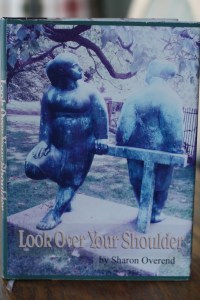
What is your working title of your book?     LOOK OVER YOUR SHOULDER

A mock-up of my novel that I have placed in front of my desk to remind me what I'm there to do.

A mock-up of my novel that I have placed in front of my desk to remind me what I’m there to do.

What is the one-sentence synopsis of your book? Look Over Your Shoulder is a story about forgiveness and redemption.

Who or what inspired you to write this book?

In 2004 my dear friend, Heidi Stanzel McIssac, was told she needed a bone marrow transplant to beat leukemia that she had battled most of her adult life. Being an only child with her father from Germany and her mother from South Africa, finding a suitable donor was not going to be easy. When a donor was not found within Heidi’s extended family, the search broadened to include media campaigns overseas. Eventually, a donor was located and Heidi received her transplant only to have her body rejected the donor marrow. Heidi passed away on September 16, 2004, leaving behind a thirteen year old daughter and parents who, most likely, will never recovered from their lose.

Where did the idea come from for the book?

Heidi’s attempts to educate people about bone marrow transplants and her death made me take a look at my own family. I come from a large, Roman Catholic family. I have three siblings and ten first cousins. My ancestry is a Celtic cocktail of English, Irish and Scottish with a dash of French to add some heat to the mix. I suspect if I were to ever need a transplant, one would be easy enough to find. This got me thinking. What if someone from a large, dysfunctional family required a transplant and the only match available came from the least reliable person in the clan.

What genre does your book fall under? Literary Fiction

Will your book be self-published or represented by an agency? My hope is to find an agent.

How long did it take you to write the first draft of your manuscript? I was able to finish the first draft of my novel in a year.

What other books would you compare this story to within your genre?

Although the stories are different, I would like to think the style I have written Look Over Your Shoulder will remind readers of Jane Hamilton’s – A Map of the World, or Gail Anderson-Dargatz’s – Turtle Valley.

What else about your book might pique the reader’s interest?

Since no one ever sees the same situation the same way, I thought it would fun to write this story from the point of view of three players—Anne, Burt and Barb.

Everyone looks to Anne, the matriarch, for guidance as they wade through the biggest crisis to ever face their family. Before she can help them, Anne must first confront her feelings of guilt and must make peace with a God she’s convinced has abandoned her.

Burt’s years of self-destructive behaviour have destroyed two marriages, pushed his three sons away and taught his family that he can’t be trusted. He is the last person anyone feels they can count on, and the only match for his sister. Although nervous about the transplant procedure, he comes to see this as an opportunity to redeem himself in the eyes of his family.

Barb, the youngest sibling, seldom thinks of anyone other than herself. When Lizzie’s body begins to reject Burt’s marrow, Barb is faced with the real possibility that she could lose the only person she feels has ever accepted her. Yet, true to form, Barb throws risky distractions between herself and the truth of what life without her closest sister could mean.

Which actors would you choose to play your characters in a movie rendition?

Anne – Shirley MacLaine, Burt – Robert Downey Jr, Barb – Julianne Moore.

Thanks again, Heather and tag, you’re it, Kate Arms-Roberts and others who still have to give me permission to use their names.

Kate Arms-Roberts is a Toronto-based writer, though she has hailed from various locations in the U.S. and U.K. before landing in Canada. She blogs at http://www.katearmsroberts.wordpress.com and is currently working on a fantasy novel for teens.

11 Comments

Filed under Writer's blog, Writer's journey, writing,

Looking Back

So here I am almost a year after I wrote my first blog post and I am looking back over 2012.

OMG what a year it has been!

Although I am not able to boast that I have finished my novel, I am proud to say I have ticked off a good number of the goals I set for myself last January. Professionally, I feel in 2012 I stepped ahead several paces. Personally, I will freely admit, it has been a most difficult year.

The first half of 2012, I wrote every day. Some days it was good and more days than not, it wasn’t as good as I would have liked, but I never stopped writing. And I was so very happy. Then as June was finishing off and I was feeling in control of my work and my life—well, as they say—all crap hit the fan and I was asked to once again parent a child. Anyone who has spent time caring for a child will tell you it is the most difficult and most rewarding job you will ever do. I am happy, very, very happy to have had this opportunity, but alas, being a primary caregiver after your own children are grown isn’t the natural order, and consequently, the last six months have been a challenge on several levels.

One of the challenges I faced was in finding both the time and the energy to write. Three months into my new role, life did start to take on a routine and I was able to squeeze an hour of writing here and an hour there, not what I had been managing, but enough to finish off my requirements before receiving a Certificate in Creative Writing from U of T this past November. Unfortunately, my new commitment kept me from my long-standing writing circle and I left the group in October.

It has been a sad year, but it is coming to an end.

Now, as I look ahead to 2013, I am resisting the urge to imagine myself and my novel alone in a rubber dingy, cast out at sea. After all, there is no one pushing me to submit twenty newly edited pages every two weeks. There is no final project requiring me to produce seventy-five polished pages hanging over my head. No agents or publishers are waiting to see my finished manuscript. It is just me, a laptop, and a story that I must tell.

What am I going to do?

I’m going to hug the darling three-year-old I have had the privilege to care for over the past six months. I’m going to take what I can from 2012 and I’m going to make good art.

Then, I’m going to write, damn it.

As always I like to hear your stories. Did you manage to tick off anything on your 2012 TO DO list?

Did you make good art?

6 Comments

Filed under Writer's blog, Writer's journey, writing,

How Did You Know That?

I don’t have an inspirational video or photo to support this post. I looked, but suspect it isn’t something writers are always comfortable talking about. Maybe it’s too weird a concept for even us to fully own¸ but I’ll bet you dollars to donuts that if you’ve been writing long enough it has happened to you.

You’ve written an original scene, maybe even wondered where it came from and then something in your work materializes in your real life. Cue the Twilight Zone soundtrack.

It’s happened to me more than once. Kind of like when you think of someone and then they call you.

People today are more willing to accept that thought is energy and when you are receptive, you are able to pick up that energy. Like you have a butterfly net just as a butterfly is flying past you. So when you think of a specific person it’s entirely probable that is because they are thinking about you.

Okay, I’m buying it so far, but can you explain what is happening when I name a character and soon after meet someone with that name. I’m not talking about your Mikes and Bobs or Sallys and Sues, I mean unusual names, names you don’t hear every day. Do you think I’m picking up the energy of someone’s path about to cross mine? Maybe yes, maybe not. I don’t have the answer.

I had an instructor once who warned her creative writing students to not get freaked out if they wrote something only to have it happen in their life. She suggested by nature writers are observers and people watchers and that often times we observe and pick up things without realizing we are even looking. Recently, a guest speaker at my monthly writers’ breakfast called it her writer’s brain which saw and processed more than her normal brain could ever hope to absorb.

In other words, you may be watching your sister and her husband and not know that you have picked up the subtle signs that he is cheating on her. Soon afterward, your male protagonist has an affair. Then you hear that your brother-in-law is cheating on your sister. The coincidence may weird you out, but in reality your writer’s brain saw the affair and you plopped it down on the page.

To push this point a bit further, I suspect when I am writing and am in the zone that I have slipped into theta brainwaves. (Theta brain waves, measured at 4-7 Hz, are the brain state of REM sleep (dreams), hypnosis, lucid dreaming, and the barely conscious state just before sleeping and just after waking. Theta is the border between the conscious and the subconscious world, and by learning to use a conscious, waking Theta brain wave we can access and influence the powerful subconscious part of ourselves that is normally inaccessible to our waking minds.) It makes sense that when you are in theta that you are able to access the stuff you didn’t know you saw.

So, I still think I might be a bit psychic, but more likely I have a big, fat writer’s brain.

I would love to hear when and where this has happened to you.

4 Comments

Filed under Writer's blog, Writer's journey, Writing

Inserting A New Routine Into An Old Habit

Well, the summer is almost over and as the cooler nights breeze over my sweaty skin (it has been a particularly HOT summer in The Greater Toronto Area), I am feeling hopeful that I may soon return to my beloved writing. After a challenging few months, my life is slowly but surely quieting, or at least approaching what I suspect will be my new normal and I expect to be pumping out regular posts in the near future. In the meantime, I have once again asked my friend, Heidi Croot, to share what she sees as her biggest obstacle in producing the kind of writing she yearns to produce.

Inserting a new routine into an old habit

By: Heidi Croot

As a business writer struggling to find my inner writer’s voice, I seek advice everywhere, from great authors to beginning writers alike. None of them tells me what I want to hear: that one day I will wake, lift my pen, and begin writing—the business mantle miraculously lifted from my shoulders, the creative mantle just as magically applied.

What every one of them does say, dag nab it all, is “write something every day.”

Much as I might wish otherwise, I know that business writing does not count.

Nor does journaling count: not my type of journaling anyway. Like many writers, I keep a journal for whinging and whining about life’s woes, and occasionally celebrating the many blessings in my life. These entries are rough and personal, meant to bleed off the darkness and stay in darkness. They are not meant for honing.

My other journals are even less appropriate: the one I keep to record my exercise workouts, for example. Another to catalogue what I serve guests for dinner, used to inspire future menus and avoid repeating mistakes. Another to corral compelling quotes from books and magazines. Another to capture elusive ideas at night. Another to keep track of conversations with, and activities in aid of, my mother. My copious travel journals. And perhaps the most functional of all, the journal I’ve been opening in Microsoft Office Word every morning for 15 years to record my business activities, and on which I depend to accurately bill my clients each month.

Clearly, I have journals aplenty in my life, just not one that fosters creative writing.

And that’s when it hits me, like a big wet fish across the chops. I have a habit that works. Why not insert a new routine into a decades-old pattern of activities that I’ve proved can meet my needs?

What, I ask myself, if I were to open a second Word file each morning? What if I call it, simply, Creative Writing: September 2012? What if I leave it open on my desktop—obvious, insistent, tantalizing—until I fulfill my promise to “write something every day”? And what if, at the end of each daily offering, I jot ideas to juice the next day, perhaps even craft an opening sentence if I’m feeling creative?

What if I tried that? After all, if it works for my business, why not for me?

Round one is today’s guest entry for my good friend and mentor Sharon and her blog. Tomorrow I begin in earnest.

Heidi Croot is an award-winning business writer who has been connecting the five essential dots of communication for employees, customers and the community for more than 30 years. As principal of Croot Communications, she writes magazine articles, newsletters, brochures, annual reports, speeches, strategic plans, and more.

2 Comments

Filed under Writer's blog, Writer's journey, Writing

Stories In Old Attics

I was the kind of kid who happily sat with my grandmothers (both born in 1913) as they spun  tales of life growing up in Toronto in the twenties, surviving the Great Depression and World War II, becoming newlyweds in the thirties and young mothers in the forties.

With one Irish-Canadian grandmother and one French-Canadian grandmother, I learned my bard skills. I’m so grateful that both women lived into their mid-eighties and by the time they passed, we had clocked hundreds of storytelling hours together. (My first novel, safely stored in the bottom drawer of my desk and sadly not likely to see the light of day, was set in early twentieth century Toronto and loosely based on one grandmother’s life.)

Unfortunately, I know less about my grandfathers and their lives. Although my paternal grandmother was able to tell me where my Canadian born grandfather had lived as a child, his passing at age forty-eight meant I would never hear him tell about servicing in the Canadian Air Force during WWII or anecdotes from his life that only he would know.

My Scottish grandfather was killed in a work-related accident when I was eleven and at the time of his death, he had just begun to see me as a person rather than another noisy kid. One of my last memories of him was of sitting on the front porch and listening as he told me how he left his family’s Highland farm at the age of sixteen in search of a new adventure and of his plans to farm in Saskatchewan, Canada. As luck would have it, his arrival in Saskatchewan coincided with the harsh and unrelenting draught of the Great Depression and his new farmland refused to yield a decent crop. He died before he shared with me why he hadn’t simply packed up and returned to Scotland, but instead found his way back east to Toronto.

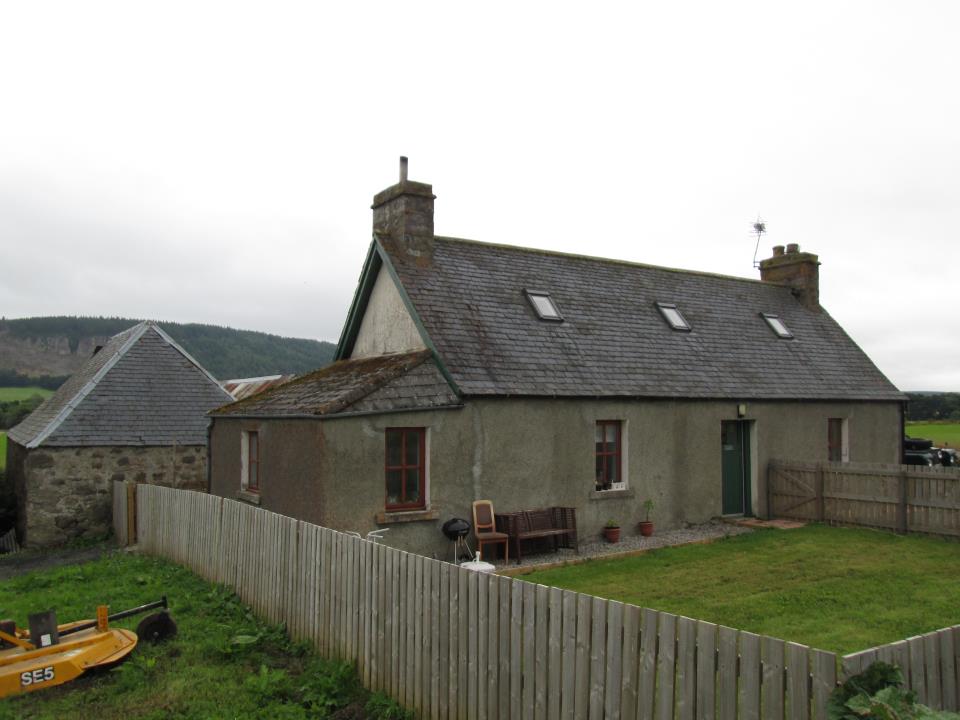
After his death, and knowing how we had begun to connect through his stories of the old country, my grandmother took me and my oldest cousin to visit his birthplace; Muir of Ord, Rosshire, Scotland. Every fibre of the romantic storyteller in me tingled the moment I clapped eyes on the centuries old farmhouse where generations of my family had lived, worked and died.

If only those walls could talk!

What foods did my great-grandmothers prepare in their kitchens? How many children were born in the upstairs rooms with the sloped ceilings? What thoughts ran through the men’s minds as they peered out those small windows cut into the roof? What conversations were had around the fireplaces? What good times and what bad times were played out behind the front door? Why had Grandpa left?

This past week, my sister made the pilgrimage to Muir of Ord and shared this picture of the Murchison farmhouse. Tonight, I find myself staring at the photo and am bombarded with the flood of a thousand stories waiting to be told using this farm as my setting.

I’ve asked before, where do you find stories ideas? Lately, I’m finding many of my ideas are coming from settings that pop out at me.

Has a real setting ever offered you a story idea? Do share.

4 Comments

Filed under Writer's blog, Writer's journey, writing,

Imagine This

Imagination is more important than knowledge.  ALBERT EINSTEIN

Imagination, also called the faculty of imagining, is the ability of forming mental images, sensations and concepts, in a moment when they are not perceived through sight, hearing or other senses. It is seeing something that is not yet here. It is seeing a different future. It is seeing a combination of existing products that has not yet been tried.  SIR KEN ROBINSON

Yesterday, I made puppy soup. (No live puppies were used or harmed in the making of said puppy soup although one Cocker Spaniel was asked to participate in the taste testing.) Today, using my super powers, I flew with two robins and collected twigs for our nest.

Playing with my two-and-a-half-year-old granddaughter has reminded me of the importance of imagination. Through play children not only learn about themselves, their talents, as well as test their skills and abilities, but also discover what they need to know about the world around them. For bigger kids imagination is equally important. Imagination is the root of all creativity, problem solving, scientific discoveries and every invention ever developed.

The part of the brain responsible for imagination is located in the frontal lobes which is also responsible for facilitating reflection, empathy, play and creativity. There are two basic types of imagination: Imitative imagination and creative imagination.

Imitative imagination is the mind’s reconstruction of the past where we use our memory to picture something we have experienced and recreate it. Making puppy soup was my granddaughter’s way of recreating the experience of watching me chop vegetables, add them to a broth, stir the concoction and serve out bowls of homemade soup.

Creative imagination is the restructuring of past sensory impressions. Mental imagery of past images or experiences constructs sensations or conditions never before experienced. Without ever having been on a Caribbean cruise, we are still able to close our eyes and imagine a ship, cabins and turquoise water.

Like most children, growing up I had a healthy imagination—some called it overactive. To a daydreamer kind of kid like me, becoming a writer was a logical career choice. Writers know about imagination.

When my children were young, I watched their toy boxes fill up with dolls that crawled and robots that moved, then watched as these expensive, hard plastic, battery-operated, one trick ponies made their way to the bottom of the boxes, destined never to become the favourite toy. What were the favourite toys? There was Teddy (a stuffed Teddy Bear), Bunny (a stuffed bunny rabbit) and a doll named Irma. What each favourite toy had in common was it did absolutely nothing. Its appeal, and indeed staying power lay, in the invitation to imagine and create.

People lacking an imagination (I’m sure you know a few) are at best, dull and at worst, scary. I wonder whether the absence of imagination and abundance of people who grew up with automated toys that limited how children played might explain what is wrong with the world today.

What have you daydreamed about today? Did you seeing something that is not yet here? Did you let your imagination out to play?

Here’s a video from the Grande Dame of Imagination, J.K. Rowlings, as she delivers a commencement speech to the Harvard class of 2008.


4 Comments

Filed under Writer's blog, Writer's journey, writing,

Is writing, writing?

Several months ago, I wrote about the value of surrounding yourself (and your writing) with good and trusted tribe members. Now, I would like to introduce some of my tribe to you. I have asked a few of my writer friends to help me with guest blogs as I take some time to refocus my energy on my family. Today’s post is from a very dear friend, Heidi Croot, who is transitioning between corporate writing to non-fiction and fiction writing. I know if the shoe was on the other foot and I had to transition from fiction to corporate writing, I would feel some of what she has expressed below.

Many of you have asked me what gives? Where are the new posts? How’s the book coming along? Did you ever send in your 75 pages for your final project? The short answer is I have not been able to find much time to write in the last month. Unfortunately, one of our children is unwell and my husband and I are caring for our young granddaughter. It is indeed a challenging time, but I thank everyone who is checking in with us regularly and holding us in their thoughts and prayers. I am indeed blessed to have such a large and supportive tribe and know we will get through this difficult time.

Sharon

Is writing, writing?

By: Heidi Croot

So, here’s the dilemma. And it’s a gnawer.

I’m a corporate writer, a business writer. Have been for more than 30 years. It means I write annual reports, employee newsletters, articles for trade press, even corporate communications plans.

Fine and good.

However, what I want to do, desperately, is break into personal writing: memoir, fiction, poetry.

Isn’t writing, writing?  If I can do it in one genre, shouldn’t I be able to transition easily to another?

Apparently not.

I am paralyzed. Have no idea how to get started on, say, a short story. What would I write about? What on earth would I write about? Does plot piece together like ideas in a non-fiction piece? Who is my character? And what the hell does she want? How do I select point-of-view, describe people’s faces, evoke a setting, create suspense?

I don’t fumble like this with magazine articles. I know exactly what to do. How to begin. How to organize my material (indeed, where to get my material). How to bridge paragraphs. What tone to take. When to use stories or case studies.

I turn to mind-mapping, an indispensable tool of my trade, but it lets me down. I don’t even know what to put in the centre cloud. So I put a question mark. That really helps.

There must be a bridge from genre to genre. Got to find it. Meanwhile, I tear around, choking on my own dust, mild hysteria mounting as I face the prospect of being stuck on this island forever.

Plunge in, just start, practice, practice, practice: I hear you, all you capable fiction writers out there.

I know my voice is in here, somewhere deep, buried under the detritus of dry corporate babblespeak. Going to get me a tractor and clear all that rubble aside. Let the music out. Soon, I’ll do it soon. First I’ve got to finish that business report.

Heidi Croot is an award-winning business writer who has been connecting the five essential dots of communication for employees, customers and the community for more than 30 years. As principal of Croot Communications, she writes magazine articles, newsletters, brochures, annual reports, speeches, strategic plans, and more.

3 Comments

Filed under Writer's blog, Writer's journey, Writing, writing,

Make Good Art

This past week marked the one year anniversary of my leaving my day job and I am now taking stock of what I have accomplished with my writing. On the surface some might judge, not much, but the truth is I have leaved more in this past twelve months than in the previous decade of studying my craft. Although courses and workshops are valuable there is no substitute for butt-in-the-chair and trial-by-error. By trying different points of view, tenses, and storylines, I have been able to stretch myself as a writer. Last night, I had the opportunity to look over the first pages I worked on last July. I had thought they were pretty good, but now see everything that is wrong with them. For a moment I felt discouraged, then I recognized my growth and I now feel grateful. I’m grateful first and foremost to my family who have allowed me this time to stretch my wings and I’m thankful to my instructors and peers who have held my hand along the way.

So what’s next. Although I will not be getting another job in the immediate future, my time has been redirected and writing full-time is no longer possible (at least for the next few months). I have fought feelings of disappointment for the past week, but am now resigned, maybe even excited about the next chapter in my life. While working full-time I managed to write, a lot it seems in retrospect, and now I’m back to stealing minutes to work. Since I’ve resolved to hold tight to my writing dream, there is no turning back and I will do what it takes to keep up with my work. Who knows, I might become a more focused, and dare I hope, better writer.

Here is a video I have watched over and over again. I can relate too much of what Neil Gaiman speaks about in this commencement speech, particularly his point about making good art when life throws you a curve ball. A curve ball has been thrown my way and I intend to take it and make good art.

2 Comments

Filed under Writer's blog, Writer's journey, Writing, writing,

4 Ways Gardening is Like Editing

This post originally appeared on Kate Arms-Roberts’ blog about writing and creativity on April 12, 2011. Now that it is summer and a year later, her garden is in a more mature stage of development and so is her novel, but the analogy remains a good one.

Irises and crocuses are blooming in my garden. Perennial herbs and vegetables are showing signs of life after the dormancy of a Northern winter.

Inside the house, I have completed the first complete critique of my novel. Pages of corrections wait for me to enter them into the computer.

And, as so often happens, these two simultaneous happenings have made me aware of connections I had not previously articulated: parallels between gardening and editing.

1. Location, Location, Location

Plants need the right conditions: soil, light, water all must feed the plant for it to grow. Sometimes you need to move a plant for it to thrive.

Scenes need to fall in the right place. Sometimes you write a scene for the middle of the story and then realize it works better at the beginning.

2. Treatment Matters

Too much water or fertilizer may kill plants as easily as too little.

Backstory needs to be dripped in like irrigation pipes bringing just enough water to the right plant to drive growth without flooding. Action without pauses for reflection may exhaust some readers.

3. Dormancy Can be Good

Last year, I planted rhubarb in my garden. A friend divided hers and gave me half. I knew nothing of rhubarb, but she said it was hard to kill. I planted it, and watered it. A few leaves died, and a few stayed green all summer, but there was no new growth. In the fall, it died back all the way to the ground. Having no understanding of the ways of rhubarb, I watched, wondering if this was, indeed, a survivor. A few days ago, I noticed bright red growth in the midst of the dead material. This morning, there are leaves coming out. This rhubarb will live!

I wrote the first draft of my novel last November. In December, I read it once and noted a few sections that needed to be cut and a few sections that needed to be fleshed out. Then, before I could revise it properly, I needed to let the project go dormant. For three months, I focused on directing a play. As the play neared production, I went back to the manuscript. By leaving it for a time, I was able to come back with a sense of perspective and a deeper understanding of some of the story elements I had glossed over in the first draft. This novel, too, may live!

4. Start With What You Have

The first house I lived in had an overgrown front yard and a mess of a backyard. To quickly beautify the landscaping, there was nothing to do but dig out the front and start again in both areas. So, we did.

Like that house, my first NaNoWriMo manuscript is a mess. Having looked at it through several editing lenses over the past few years, I have concluded there are no more than 3 scenes that might be worth saving, and those probably won′t be usable once I rewrite the rest. If I want to tell that story, I will be better off starting again from scratch.

Our current house had been cared for well by the previous owner, but featured plants I find boring or actively dislike. I have made changes slowly, looking at what is already in place and deciding how to convert it into something I like better without ever going through the completely dug up phase.

My current work-in-progress is similar. The first draft was strong enough that it holds together as a story. It needs major revision, but the core is strong. Editing what is there will work.

Editing a manuscript and gardening are both about looking at what already exists and making changes to bring that reality closer to an imagined goal.

I planted iris bulbs last fall after clearing space in an uninspiring flower bed. Seeing them bloom this year makes me smile. There are small clumps of them now. I hope they naturalize well and create bigger groupings for the future.

It may take time, but editing a garden or a manuscript produces results eventually.

Kate Arms-Roberts is a Toronto-based writer, though she has hailed from various locations in the U.S. and U.K. before landing in Canada. She blogs at http://www.katearmsroberts.wordpress.com and is currently working on a fantasy novel for teens.

5 Comments

Filed under Writer's blog, Writer's journey, Writing, writing,