

Tag Archives: creativity

Writing about Grown‑Up Friendships

Strong friendships can increase your lifespan by up to 50%, lower your stress levels, and reduce your risk of depression, high blood pressure, and even chronic illnesses.

All good, yeah. Who doesn’t want to be healthier?

When we’re younger, friends just… happen. You sit beside someone in class, or you share a shift at a terrible job, or you bond over the fact that you both survived the same haircut trend. But in middle age, friendship is a choice. A deliberate, hopeful, slightly vulnerable choice.

We’re all wandering around with our emotional tote bags full of past friendships, heartbreaks, and half‑finished self‑help books, hoping to stumble into someone who gets our jokes and doesn’t judge our YouTube feed.

Middle‑age friendships skip the performance. There’s no pretending to be cooler, calmer, or more put together than you are. Everyone is too tired for that. You show up as your real self — the one who has opinions about laundry detergent and about how over the speed limit is too over the speed limit.

Adult friendship is built on tiny, ridiculous moments:

  • The shared eye roll across a crowded room
  • The “tell me everything” voice note
  • The way they know your coffee order, your coping mechanisms, and your favourite band from back in the day
  • The fact that they’ve seen you cry, laugh‑snort, and rage‑clean

There’s something beautifully hopeful about new friendships — the idea that even now, even with all the history and heartbreak and hard‑won wisdom we carry, there are still people out there who will get us. Who will laugh with us. Who will sit beside us in the messy middle of life and say, “Same.”

But building and maintaining new friendships at a time in life when everyone is juggling careers, kids, aging parents, existential dread, and the sudden realization that staying up past 10 p.m. now requires a recovery period is a big ask — a next‑level commitment.

Worth it? Absolutely.

I’ve had the great fortune in middle age to have met and curated some of the most meaningful friendships of my life. These connections — the ones that feel earned and carry an emotional honesty that only shows up once you’ve lived long enough to stop pretending — are what drew me to writing about friendships.

Writing about adult friendships means writing characters who bond over shared exhaustion, mutual grievances, and complicated backstories. As a writer, I’m juggling characters with decades of personality quirks, emotional scar tissue, and the hilarious reality that grown‑ups can absolutely form a lifelong bond over one good conversation in a parking lot. These relationships are messy, layered, and wildly relatable.

In the end, I write about adult friendships because they’re the real plot twist of middle age — the unexpected relationships that sneak in, shake things up, and prove we’re not done growing yet.

Here’s to the brave, awkward, hilarious act of making new friends in the middle of life. And to telling their stories!

Leave a comment

Filed under Writing

Writing Characters Who Are Starting Over at Midlife

Ah, midlife. Where achy joints and the consequences of past mistakes become real. The temptation to think of it as a cliff we tumble over—or a force we have to fight against—is reinforced by the messaging that assaults us every day. But here’s what I’ve figured out: midlife isn’t a crisis. It’s a recalibration, a period when the brain, the body, and the self all quietly renegotiate what matters.

Adult‑development research has found that midlife is actually a phase of increased emotional stability. Not because life gets easier, but because our priorities shift. We become more selective about where we put our energy. We stop chasing every expectation. We start choosing with intention.

In 2015, my husband and I moved to the country—yup, right around the time we hit our midlife sweet spot. Maybe it was the move, maybe the country air, maybe just being midlife, but soon I found myself knee-deep in my own recalibration. I now had the time and space to examine the decisions I’d made—both in life and in my career. It didn’t take long to realize most of them had been shaped by duty and societal expectations. And since the truth had only ever been a whisper away, it took no time at all to see what needed to change. I was a writer who wasn’t writing enough, and that needed to shift. The shift was shifting. The starting over was starting.

I began work on my second novel, Stillwater Lake, which—unsurprisingly—became a story about new beginnings and the complicated courage it takes to start over.

In the book, Tallie and Jim, both middle‑aged, aren’t running toward a shiny new beginning. They’re walking, slowly and reluctantly, toward the truth. The stakes feel different. More intimate. More earned. They’re not trying to become someone new; they’re trying to become a more honest version of themselves.

It took what wasn’t working to stop working, and an ice storm to force them into a much needed moment of stillness. Midlife does that—it interrupts us. It asks us to look honestly at what we’ve carried and what we’re still clinging to. Starting over isn’t dramatic or glamorous. It’s incremental. It’s the slow work of resting when we need to, returning to what matters, facing what we’ve avoided, and letting go of the idea that it’s too late to change.

New beginnings are scary—but maybe the bravest decisions we’ll ever make.

Leave a comment

Filed under Writing

The Moment That Started It All

Why did I write Look Over Your Shoulder? And more specifically—why this story?

Simple. Grief made me do it.

Twenty-two years ago, I lost a dear friend to leukemia. Heidi was an only child with rare lineage, which made finding a bone marrow donor within her extended family nearly impossible. At the time, she had a 13-year-old daughter and every reason to fight. So, she pulled on the boxing gloves and jumped in the ring. An international search began, and eventually, a match was found—an anonymous donor willing to give her a chance.

Then Toronto was gripped by the SARS pandemic.

Today, we understand what a pandemic means to society. But in 2003, our understanding was vague. Quarantines were strict. Visitors weren’t allowed in hospitals. After her transplant, Heidi was isolated—cut off from the very people she needed most. She and her family launched a fierce campaign to change the hospital’s no-visitors policy. She contacted local media. She made noise. And she won.

But despite all of it, just weeks after the transplant, Heidi lost her battle.

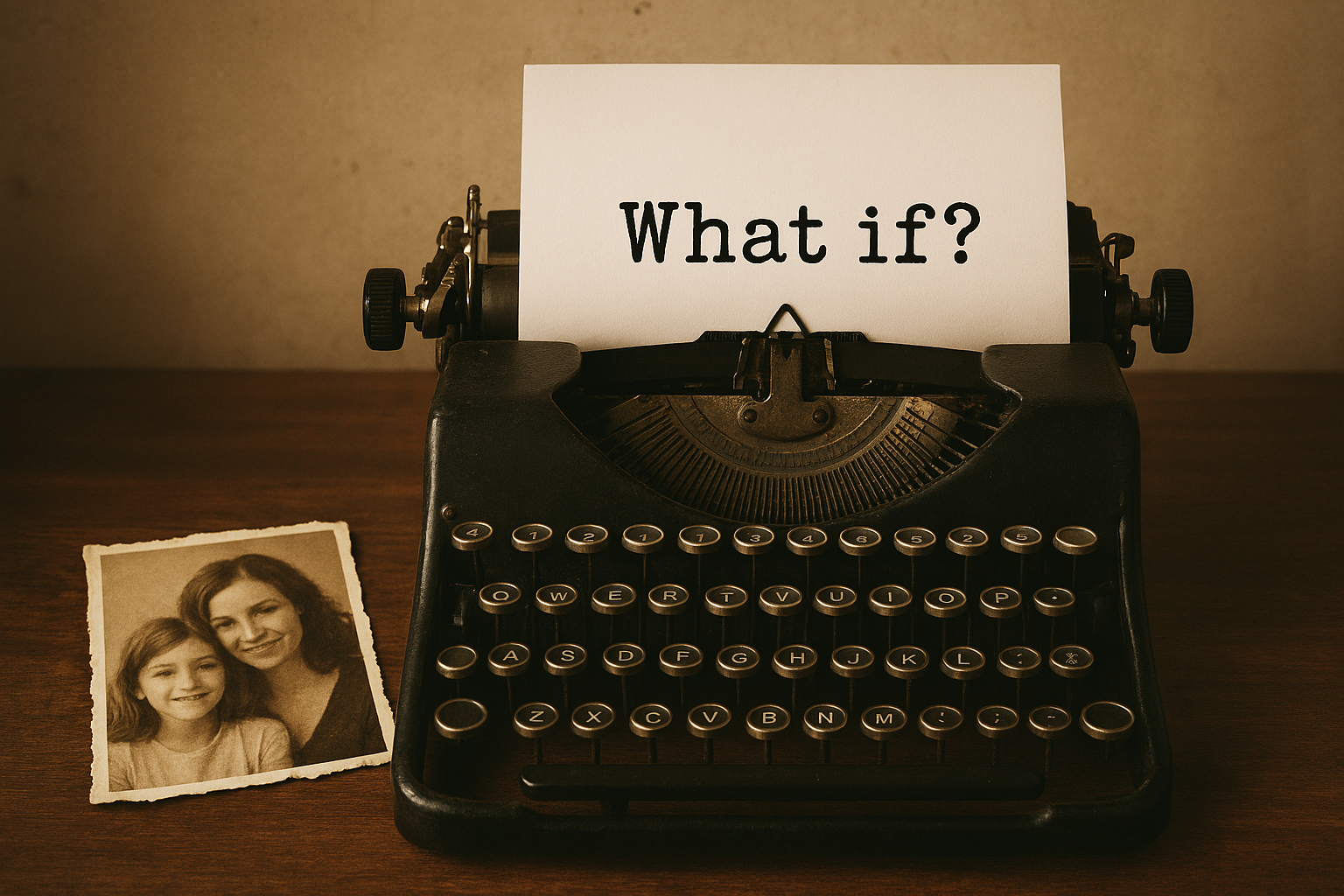
Once I moved through the early stages of grief, the “what ifs” began to loop. What if she’d found a donor within her family? What if she’d received treatment earlier? What if the system had bent sooner?

Lucky me—I have a built-in grief buster: writing.

To explain my loss and make peace with those looping questions, I began a new story. In it, I asked: what if a leukemia patient did find a donor within their immediate family? But unlike Heidi’s donor—who never knew their generous gift hadn’t saved her—this donor had to watch as their loved one’s body rejected the transplant. And what if that donor was the one person in the family least equipped to handle either the procedure or the decline?

And so, Look Over Your Shoulder began.

My wheelhouse is character. And this book is full of them. Through writing this story, I didn’t just learn how to shape a novel—I learned how different people carry grief. How they bury it. How they wear it. How they survive it.

Look Over Your Shoulder started from loss. But quickly became something more: a way to understand love, legacy, and the fragile threads that bind us.

💥 You can pre-order your Look Over Your Shoulder e-book now and take advantage of this introductory price: https://books2read.com/u/bzGr7z

💥 Print version will be available for sale on October 21, 2025.

Leave a comment

Filed under Writing

A Village

Every once in awhile, I think I should, must, no other option available, quit writing. It isn’t that I don’t want to write, it’s that I think I can’t write well enough, basically that I suck. On my really dark days, I worry I’m like one of those contestants on a reality talent show who thinks they’re the next Adele only to be told they’re delusional and shouldn’t leave their day job

Recently, I had one of those days after having submitted my latest work-in-progress to my critique group. When word came down—go back, it’s not good enough—no hyperbole, I was DEVASTATED, CRUSHED, a snivelling, whimpering puddle of pathetic doggy dodo.

Never before have I worked so hard to come up with—what I believed I was hearing—such a shitty piece of writing. How could this be? How could I have gotten it so wrong? I’ve quit my day job to give myself the time and space to create literary masterpieces for GD sake.

Then something wonderful happened. My writer friends rallied around me—more than one carrying a sharp stick happily aimed at my ribcage. Some of the very people who were (politely) telling me they weren’t feeling a connection to my characters and didn’t care to turn the page, were the very people who sent me private emails, called me on the phone, offered to look at my re-writes before I re-submitted and took me out for tea. They helped me realize that when I thought I heard, it’ll NEVER be good enough, you loser, what was really being said was, it’s not good enough YET. Who were these wonderful folks? They were my tribe, my peeps. I’d reached out my hand and they’d pulled me away from the cliff. My tribe believed in me. Maybe I didn’t suck

People, all people, need connection in the same way as they need food and water. Connection is a necessity not a luxury. Every one of us, not just writer, but I think especially writers who by the nature of the beast spend a lot of time in their heads, need to know they aren’t alone. This week, I was reminded I’m part of a village.

So, to those of you who are at the early stages of your writing careers, I would suggest you join a writing group and work on building your own tribe. Step away from your computer and introduce yourself to your village. Because if you’re serious about becoming a writer, you’ll absolutely have a dark-night-of-soul somewhere along your journey, and you’re going to need that village. It’s going to take courage and a spirit of adventure, but I promise you will get back tenfold what you give to your tribe and your village.

4 Comments

Filed under Writer's journey, Writing

Ants, Chopin, Newborns and Windows

I had ants in my office this week. I’m happy to report they’ve finally, FINALLY, vacated the premises, but not before their sheer creepiness drove me from my desk for two days. As I setup a makeshift office on our dining room table, I decided to look at my new surroundings as the change I could make instead of the rest I would have liked to take—yup, I’m still polishing those 75 pages for my final project at U of T. So instead of closing the door to my closet-sized office, and disappearing the world outside, I was forced to work among the masses—it’s not a stretch when I call the other six people, one dog and four cats that I live with, the masses. Have you ever tried to write the great Canadian novel while a darling, two-year-old created her unique interpretation of Chopin a mere five feet away from your work station? Trust me as adorable as it—as she—can be, not much work happens during the ensuing thirty minute performance. But plow through I did. To my great surprise, I did manage to rework a tricky section in my latest chapter and was able to send off twelve crisp pages of prose to my bi-weekly writing circle. Not bad.

As it happened during my week of the ant invasion, I also paid a visit to a dear friend and Doctor of Natural Medicine, who over yet another cup of Vanilla Roobios tea, heard all about my continuing struggles to produce writing that guarantees to soar to the top of any bestseller’s list. Three minutes into my rant, she suggested she could ‘fix me’, claiming she had a suspicion of exactly what was at the root of my woes. Feeling I had nothing to lose and everything to gain, I agreed and scheduled an appointment. Basically, her intention was to tap into my subconscious and help me identify my true attitudes particularly around writing and to help me change any self-limiting beliefs that may be holding me back. As with many alternative methods, this latest treatment at first seemed odd, but after an hour with her, I believe I made some inroads toward understanding and dare I hope, overcoming my fears. (Sorry, as much as I’d love to, I’ll keep the specifics of what we came up with to myself.)

On the morning of day two out of my office (one day after seeing the good doctor), I had what I can only describe as a surreal, out-of-body like experience. As I glanced around the dining room table, I saw pages and pages of my work spread about. On those pages were words, lots of words, and those words were strewn together into sentences, and the sentences were arranged into paragraphs. They were my words. They were words that had never existed in precisely that configuration before. I had created something that hadn’t existed before. Whether those words, in exactly those sentences and those paragraphs, are ever published didn’t matter in that moment, because those little darlings were mine and the gratitude I felt overwhelmed me. They had given me the greatest gift I’ve received in a very long while. Those pages, with all those words on them, gave me hope and filled me with immense pride. They represented a window into my future. Just as when I peered into the wrinkled faces of my newborn babies, I saw the path I will walk for the remainder of my days. I can never stop being a mom now that my babies are here, and I can never stop being a writer now that I’ve sat at a computer and pounded out so many newborn pages filled with newborn words.

This weekend I moved back into my office and it seems, just as my ant problem has disappeared, I feel I’ve banished some old and useless feelings that have weighed me down for too long. The words are definitely flowing more easily and I’m able to ‘stick to it’ longer.

So, thank you ants for forcing me back with the masses, for showing me the benefit of toddler style Chopin and for words scattered over a teak table.

1 Comment

Filed under Writer's blog, Writer's journey, Writing