
Tag Archives: writing

Writing about Grown‑Up Friendships

Strong friendships can increase your lifespan by up to 50%, lower your stress levels, and reduce your risk of depression, high blood pressure, and even chronic illnesses.

All good, yeah. Who doesn’t want to be healthier?

When we’re younger, friends just… happen. You sit beside someone in class, or you share a shift at a terrible job, or you bond over the fact that you both survived the same haircut trend. But in middle age, friendship is a choice. A deliberate, hopeful, slightly vulnerable choice.

We’re all wandering around with our emotional tote bags full of past friendships, heartbreaks, and half‑finished self‑help books, hoping to stumble into someone who gets our jokes and doesn’t judge our YouTube feed.

Middle‑age friendships skip the performance. There’s no pretending to be cooler, calmer, or more put together than you are. Everyone is too tired for that. You show up as your real self — the one who has opinions about laundry detergent and about how over the speed limit is too over the speed limit.

Adult friendship is built on tiny, ridiculous moments:

  • The shared eye roll across a crowded room
  • The “tell me everything” voice note
  • The way they know your coffee order, your coping mechanisms, and your favourite band from back in the day
  • The fact that they’ve seen you cry, laugh‑snort, and rage‑clean

There’s something beautifully hopeful about new friendships — the idea that even now, even with all the history and heartbreak and hard‑won wisdom we carry, there are still people out there who will get us. Who will laugh with us. Who will sit beside us in the messy middle of life and say, “Same.”

But building and maintaining new friendships at a time in life when everyone is juggling careers, kids, aging parents, existential dread, and the sudden realization that staying up past 10 p.m. now requires a recovery period is a big ask — a next‑level commitment.

Worth it? Absolutely.

I’ve had the great fortune in middle age to have met and curated some of the most meaningful friendships of my life. These connections — the ones that feel earned and carry an emotional honesty that only shows up once you’ve lived long enough to stop pretending — are what drew me to writing about friendships.

Writing about adult friendships means writing characters who bond over shared exhaustion, mutual grievances, and complicated backstories. As a writer, I’m juggling characters with decades of personality quirks, emotional scar tissue, and the hilarious reality that grown‑ups can absolutely form a lifelong bond over one good conversation in a parking lot. These relationships are messy, layered, and wildly relatable.

In the end, I write about adult friendships because they’re the real plot twist of middle age — the unexpected relationships that sneak in, shake things up, and prove we’re not done growing yet.

Here’s to the brave, awkward, hilarious act of making new friends in the middle of life. And to telling their stories!

Leave a comment

Filed under Writing

Writing Characters Who Are Starting Over at Midlife

Ah, midlife. Where achy joints and the consequences of past mistakes become real. The temptation to think of it as a cliff we tumble over—or a force we have to fight against—is reinforced by the messaging that assaults us every day. But here’s what I’ve figured out: midlife isn’t a crisis. It’s a recalibration, a period when the brain, the body, and the self all quietly renegotiate what matters.

Adult‑development research has found that midlife is actually a phase of increased emotional stability. Not because life gets easier, but because our priorities shift. We become more selective about where we put our energy. We stop chasing every expectation. We start choosing with intention.

In 2015, my husband and I moved to the country—yup, right around the time we hit our midlife sweet spot. Maybe it was the move, maybe the country air, maybe just being midlife, but soon I found myself knee-deep in my own recalibration. I now had the time and space to examine the decisions I’d made—both in life and in my career. It didn’t take long to realize most of them had been shaped by duty and societal expectations. And since the truth had only ever been a whisper away, it took no time at all to see what needed to change. I was a writer who wasn’t writing enough, and that needed to shift. The shift was shifting. The starting over was starting.

I began work on my second novel, Stillwater Lake, which—unsurprisingly—became a story about new beginnings and the complicated courage it takes to start over.

In the book, Tallie and Jim, both middle‑aged, aren’t running toward a shiny new beginning. They’re walking, slowly and reluctantly, toward the truth. The stakes feel different. More intimate. More earned. They’re not trying to become someone new; they’re trying to become a more honest version of themselves.

It took what wasn’t working to stop working, and an ice storm to force them into a much needed moment of stillness. Midlife does that—it interrupts us. It asks us to look honestly at what we’ve carried and what we’re still clinging to. Starting over isn’t dramatic or glamorous. It’s incremental. It’s the slow work of resting when we need to, returning to what matters, facing what we’ve avoided, and letting go of the idea that it’s too late to change.

New beginnings are scary—but maybe the bravest decisions we’ll ever make.

Leave a comment

Filed under Writing

The Moment That Started It All

Why did I write Look Over Your Shoulder? And more specifically—why this story?

Simple. Grief made me do it.

Twenty-two years ago, I lost a dear friend to leukemia. Heidi was an only child with rare lineage, which made finding a bone marrow donor within her extended family nearly impossible. At the time, she had a 13-year-old daughter and every reason to fight. So, she pulled on the boxing gloves and jumped in the ring. An international search began, and eventually, a match was found—an anonymous donor willing to give her a chance.

Then Toronto was gripped by the SARS pandemic.

Today, we understand what a pandemic means to society. But in 2003, our understanding was vague. Quarantines were strict. Visitors weren’t allowed in hospitals. After her transplant, Heidi was isolated—cut off from the very people she needed most. She and her family launched a fierce campaign to change the hospital’s no-visitors policy. She contacted local media. She made noise. And she won.

But despite all of it, just weeks after the transplant, Heidi lost her battle.

Once I moved through the early stages of grief, the “what ifs” began to loop. What if she’d found a donor within her family? What if she’d received treatment earlier? What if the system had bent sooner?

Lucky me—I have a built-in grief buster: writing.

To explain my loss and make peace with those looping questions, I began a new story. In it, I asked: what if a leukemia patient did find a donor within their immediate family? But unlike Heidi’s donor—who never knew their generous gift hadn’t saved her—this donor had to watch as their loved one’s body rejected the transplant. And what if that donor was the one person in the family least equipped to handle either the procedure or the decline?

And so, Look Over Your Shoulder began.

My wheelhouse is character. And this book is full of them. Through writing this story, I didn’t just learn how to shape a novel—I learned how different people carry grief. How they bury it. How they wear it. How they survive it.

Look Over Your Shoulder started from loss. But quickly became something more: a way to understand love, legacy, and the fragile threads that bind us.

💥 You can pre-order your Look Over Your Shoulder e-book now and take advantage of this introductory price: https://books2read.com/u/bzGr7z

💥 Print version will be available for sale on October 21, 2025.

Leave a comment

Filed under Writing

What Happens After ‘The End’: Navigating Post-Novel Blues


“Endings are merely the seeds of new beginnings waiting to bloom.” — Uncommon

I’ve written three books now, Look Over Your Shoulder, being my debut novel. I’ve heard it said most writers have one all important book they need to write. But it isn’t always their first book. Sometimes they need to get down and dirty in the mud, figure out this whole writing character and plot and setting jazz, before they feel brave enough to tackle their big book. Not how I roll.

Look Over Your Shoulder is my big story. Good or bad, I’m not sure, but being one to rarely look before I leap, and without having the damnedest clue what I was doing, I jumped right into my big story with my first novel. Not going to lie, it wasn’t an easy journey, because, yeah, I ended up learning about character and plot and setting on the fly. Consequently, finishing this book took FOREVER. Would I have it any other way—that’s a hard no.

And now my baby’s about to go big and to go wide. She’s hitting the streets on October 21, 2025. Woohoo!

My journey to releasing Look Over Your Shoulder hasn’t been a straight line, but now that I’ve held my proof copy in my hands, I feeling a sense of completion. Along with a whole bunch of other feelings.  

Finishing the story was definitely bittersweet. Ecstatic to have completed the project, I felt pretty damn proud of myself, but once that high waned, I was left with a massive emotional hangover. Although I was able to take my story on some fun-filled adventures, there were also times where I went deep and dark. Eventually, I got through the hangover period only to find moodiness and irritability stacked up right behind it. I recognized this wasn’t somewhere I wanted to land and very quickly began work on my second novel—Stillwater Lake (scheduled for release in the new year—just saying).  

Okay, fine. I softened the blow and cheated officially saying goodbye to the world I’d created in Look Over Your Shoulder when I stole a few minor characters and dragged them into Stillwater Lake. Ya gotta do what ya gotta do to get through, I guess.

Today, I feel I’ve come full circle. I’m readings my proof and feeling nostalgic. I’m revisiting my characters, the settings and individual scenes, and I’m remembering where I was when I wrote them, who workshopped them with me, and how I felt when I thought I nailed them. This book is a scrapbook of my writerly journey. Looking back has been nice.

What’s the moral of the story? Writers are feelers. That’s why we write. I’ve decided it’s okay to have a bunch of big feelings when you’ve finished your big story, or any project for that matter. I say sit with those feelings as long as you need to, just don’t get stuck there. You may believe in delivering your story to the world, that you’re done. I doubt it. Not only will your story now live on in your readers, but I’m betting there’s another big story inside you just waiting to bust through. Write on writers!

Pre-order Look Over Your Shoulder now and take advantage of this introductory price: https://books2read.com/u/bzGr7z

Print version will be available for sale on October 21, 2025

Leave a comment

Filed under Writer's blog, Writer's journey, Writing

Sticking Like Glue

The sun poked through a lush tree canopy, a chipmunk scurried across the deck, cicada buzzed, and waves lapped lazily onto the beach. I stared out from the screened in gazebo and knew I was in my nirvana. So why—not for the first time—did I want to hurl myself off the dock and sink to the bottom of the lake? Simple. Because my characters were throwing tantrums, and my story had decided to ditch me and take a hike down a dark, windy, dead-end alley. You might say, all a bit much. Who was I kidding? I couldn’t write a book. What a world class idiot I was to assume once I’d landed on MY story, that the cosmos would fall in line, and the most brilliant words the world had ever read would float like motes in a sunbeam onto the page. WRONGO.

That afternoon, I did the only thing I could do. I sent out an SOS. Cryssa, my friend and a fellow writer, knew all about chasing wayward characters down dark alleys.  

Hey, girl. Hate to bug, just wondering, you still got that lifeline handy?

Took some doing, but she got me out of the reeds and safely back on dry land.

Take a break. Go for a walk. Things ’ill look different when you get back.

I did, and they did.

For real, a shift had happened. I returned to a scene that suddenly clicked, and characters who’d wandered back. Oh, and they had a story to tell me. Yeah, that was the thing. They spoke, and I listened instead of the other way around.  

I got through that day, but I’m not going to lie, it wasn’t the first, nor the last time I felt overwhelmed by this story and figured I’d be doing the world a favour if I just quit. But here’s the thing, I’m a stubborn mule—also I grew up with a mom who never let me quit anything I ever started—so I stuck to it. I continued to write, and to workshop, and to edit, and to edit, and to edit, until my characters told me they were done talking.

Fast forward to today. I’m here in a different gazebo, staring at the cover for my debut novel, Look Over Your Shoulder—pre-order e-book now : https://books2read.com/u/bzGr7z Print version available October 21, 2025, just saying—and feeling pretty proud of myself. It’s happening. Woot!

Moral of the story? The highs and lows of this journey were monumental, but they do say, it’s not the destination, rather the journey that matters. True that. Along the way, I learned how to write. I learned how to give and receive critiques. I learned fear and disappointment are part of the process, for sure, but they’re not good enough excuses to quit. I found my tribe, and I found my voice. Oh, and I decided that writing was easy peazy—not!

And ya know what—I’ma gonna do it all again.

Leave a comment

Filed under Writing

Where Do You Find Stories?

So suppose you’ve run out of crazy people in your life to draw inspiration for your stories. Where would you look? I’m one of the those fortunate people who has an abundance of crazy around me, and rarely do I have to search out story ideas, but occasionally, when I want to look outside my suburban, middle-class, Canadian life to offer a twist either in character or setting, I’ve hit a roadblock and felt lost for new inspiration.

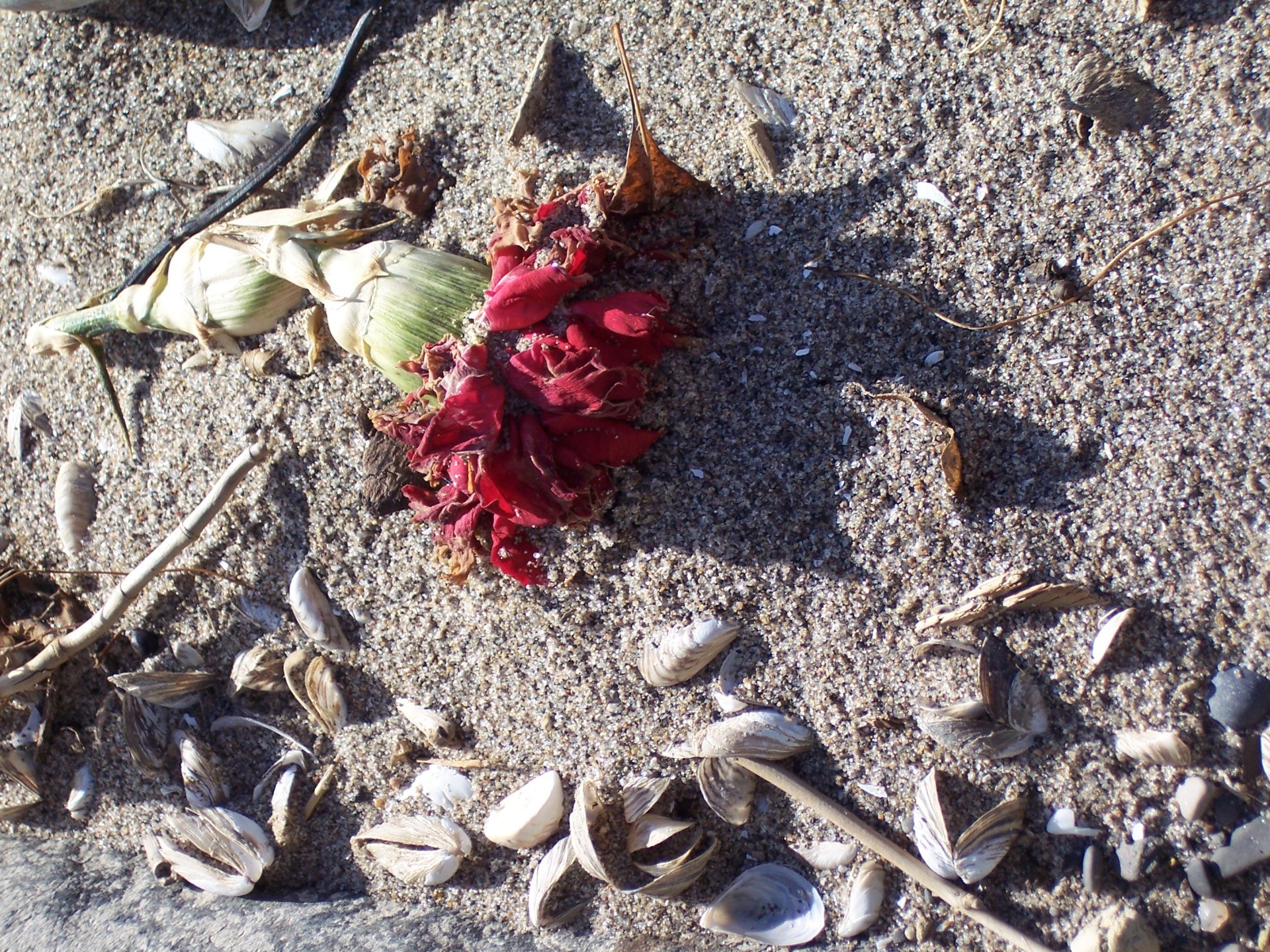
That’s when my ‘Story Ideas’ file comes in handy. In this folder are pictures and articles I’ve cut out of magazines and newspapers. I’ve also included photos I’ve taken. Here’s one of my photos. This is a carnation I found on the beach. As I snapped the picture my brain went everywhere wondering how that carnation came to be on the beach, and more importantly, why was it left at the beach. You bet I wrote a story about it. Yet another story came to me when I read an article in the newspaper that profiled the smallest retail store in the country. What a great setting for a short story.

My story ideas file has helped me with setting, character, as well as character names, titles and opening sentences.

These pictures and articles act as kick starters, but can also lead to the question; And then what? Don’t forget about what follows. Ask yourself what happened the day after. What happened the day after the carnation was left on the beach, the week after, the month after?  There may be a story hidden in the after events.

As most writers do, I carry a notebook everywhere I go. When you see an interesting sign, or overhear a conversation, jot it down. My notebook isn’t very organized, but I’ve known other writers who divide their notebooks into sections—conversations, observations, signs and billboards. Separating where you record your thoughts will make it easier to locate quirky habits and tics to flesh out your characters, or when you’re looking to incorporate interesting turns of phrasing and dialogue.

The internet is a holding ground for millions of stories. While looking  where other writers find their inspirations, I came across a video featuring Jonathan Harris. In this video Jonathan shares how he collects his stories.  Not satisfied with waiting for stories to find him, he’s developed a computer programme called We Feel Fine. The program snatches sentences that include I feel or I am feeling from worldwide blog postings. Each individual sentence is represented by a floating blob that travels across the screen and that the viewer is able to snatch and read. In some cases, you’ll find accompanying photos. A constantly changing virtual treasure trove of story ideas for a bard like me. I can’t tell you how excited I was to find this program. Although the video is several years old, the website is still available. I’ve bookmarked the page and suspect I’ll never run out of story ideas again.

http://www.wefeelfine.org/wefeelfine_pc.html

Stories are everywhere. Establish a story-finding mindset, keep your eyes and ears open and set up a story idea collection to keep your imagination sparked at all times.

http://www.ted.com/talks/jonathan_harris_collects_stories.html

Leave a comment

Filed under Writer's blog, Writer's journey, Writing